Training and Communication: 10 Proven Strategies for Workplace Success in December 2025
Your team probably spends more time clarifying what was already said than actually moving work forward. Emails get misread, feedback lands wrong, and meetings end without anyone truly aligned on next steps. This isn't because people aren't trying; it's because effective training and communication rarely happens in most workplaces. We treat it like everyone should just figure it out, but communication is a skill that improves with practice and structure. The cost of skipping this training shows up everywhere. Poor communication costs American businesses $1.2 trillion annually through project delays, rework, and turnover. But when organizations invest in teaching their teams how to listen, write clearly, and give constructive feedback, the results are visible: faster project completion, better team dynamics, and far less time wasted on misunderstandings.
TLDR:
Communication failures cost U.S. businesses $1.2 trillion annually through lost productivity and errors.
Active listening training reduces misunderstandings by teaching clarifying questions over response prep.
SMS-based training reaches frontline workers without app downloads, fitting lessons into shift breaks.
Track real ROI through meeting duration, email response times, and project revision cycles post-training.
Some modern tools deliver communication training via SMS, Teams, and Slack with 95%+ completion rates and 9× retention.
Understanding the Business Impact of Communication Training
Communication breakdowns cost more than awkward meetings. When employees can't communicate effectively, projects stall, errors multiply, and teams fragment. Research shows 86% of employees and executives cite poor collaboration or ineffective communication as a major contributor to workplace failures.
The financial impact is staggering. Miscommunication costs American businesses $1.2 trillion each year through lost productivity, project delays, employee turnover, and customer churn.
Organizations that invest in structured communication training see measurable returns. Teams resolve conflicts faster, reduce rework, and spend less time clarifying instructions. Sales cycles shorten when reps articulate value clearly. Onboarding accelerates when new hires understand expectations from day one.
The gap between high-performing and struggling teams often traces back to how well people exchange information. Clear communication training changes this from an assumed soft skill into a practiced competency that drives business outcomes.
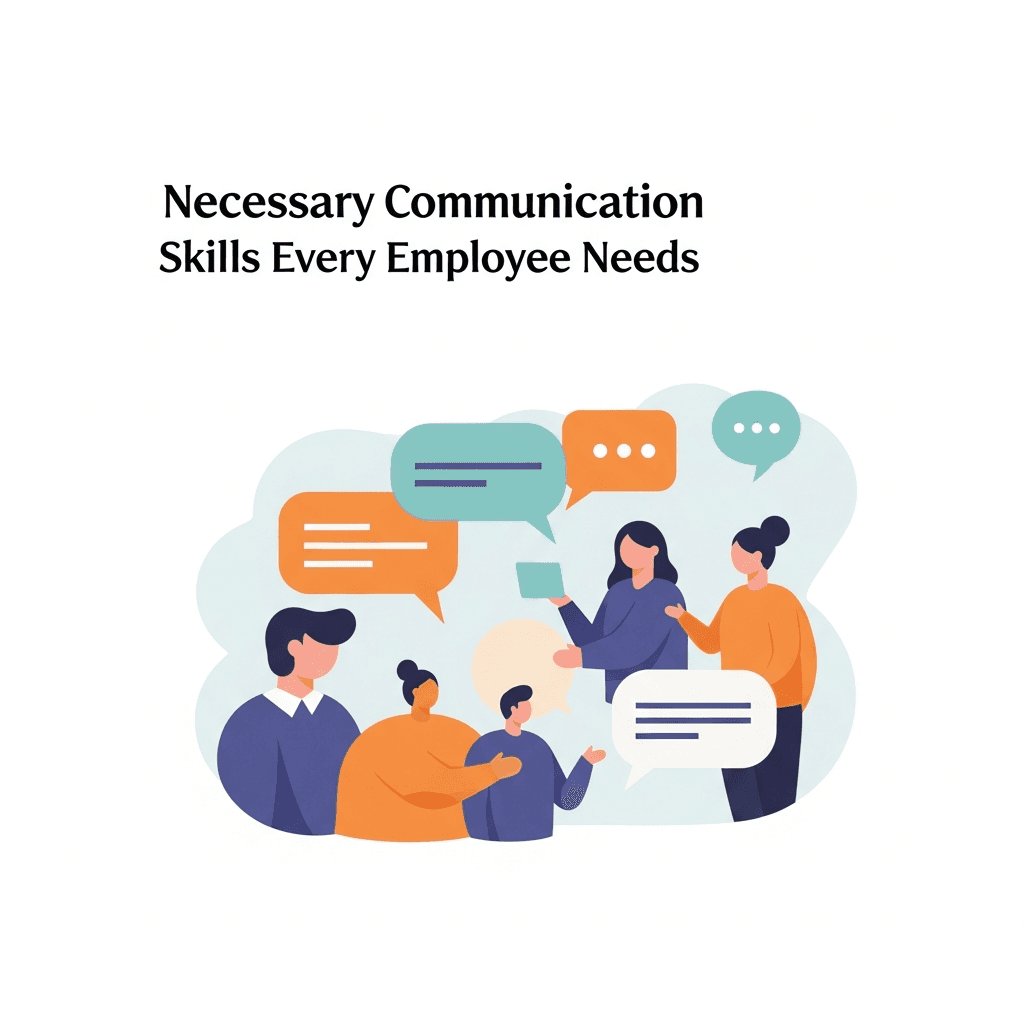
Necessary Communication Skills Every Employee Needs
Every workplace role requires learnable communication competencies that improve with training and practice.
Active Listening
Processing what others say, asking clarifying questions, and acknowledging understanding before responding prevents errors and builds stronger working relationships.
Clear Articulation
Organizing thoughts before speaking, choosing precise language, and checking for understanding saves time and reduces confusion when explaining processes, delegating tasks, or presenting findings.
Written Communication
Emails, documentation, and chat messages need to get to the point quickly, use appropriate tone, and anticipate reader questions to avoid misunderstood directives and endless clarification threads.
Constructive Feedback
Giving specific observations and actionable suggestions while remaining receptive to others' perspectives accelerates improvement without defensiveness or vagueness.
Building Active Listening Capabilities through Training
Active listening training builds observable behaviors through structured practice. Research shows that skilled listeners ask clarifying questions instead of simply staying silent.
Teaching Recognition over Response Preparation
Train employees to pause internal commentary while others speak. Exercises that require learners to summarize what they heard before responding force this mental shift and surface comprehension gaps immediately.
Practicing Clarifying Questions
Role-playing scenarios where employees must confirm details, probe for context, and surface unstated concerns builds this reflex into daily conversations. This approach tests understanding instead of relying on assumptions, reducing costly misunderstandings.
Building Nonverbal Engagement Habits
Eye contact, posture, and removing distractions signal attentiveness. Video-based training that shows contrasting examples helps teams recognize how physical presence affects information exchange during sensitive conversations or conflict resolution.
Short practice sessions in actual work contexts embed these habits more durably than single workshops.
Nonverbal Communication and Body Language Awareness
Research on emotional communication shows that nonverbal signals play an important role in how messages are interpreted, often shaping meaning beyond words alone. Crossed arms, furrowed brows, or monotone delivery shape how messages land regardless of words used.
Training employees to recognize these signals prevents misreading intent. A manager's tight jaw might signal stress, not disapproval. A colleague's lack of eye contact could reflect cultural norms instead of disengagement.
Practical Training Methods
This reveals unconscious habits like fidgeting or defensive postures that undermine messages.
Pair self-awareness exercises with interpretation practice. Show clips of workplace scenarios where teams decode the nonverbal layer, noting mismatches between spoken words and physical signals that indicate confusion, resistance, or enthusiasm.
Training for Effective Written and Digital Communication
Remote work makes written messages your primary communication channel. Unclear emails and vague chat messages create delays, duplicate work, and team friction.
Effective written communication training focuses on clarity. Every message needs a clear purpose stated upfront. Train employees to open emails with the specific request or decision needed first, then add supporting details. This prevents readers from scanning multiple paragraphs to find the actual question.
Tone gets lost in text. A sentence that feels neutral when writing it can read as abrupt or dismissive to the recipient. Adding brief context sentences reduces perceived abruptness without weakening urgency.
Chat tools need different skills than email. Teams should learn to:
Use threads to keep conversations organized and searchable
Acknowledge receipt quickly, even when a complete response takes longer
Move complex topics to video calls instead of creating sprawling message threads that confuse everyone
Documentation training teaches writers to anticipate questions. Have employees test their own instructions by asking someone unfamiliar with the task to follow them exactly as written. Missing steps and unclear language become obvious immediately.
Adapting Communication Training for Remote and Hybrid Teams
Remote and hybrid teams face communication challenges that traditional office training doesn't solve. Asynchronous work across time zones turns quick questions into extended email threads when employees can't get immediate answers.
Adapting Training for Virtual Settings
Video call fatigue affects how employees process information. Training should cover camera positioning, managing background distractions, and knowing when to disable video during extended sessions to reduce cognitive strain.
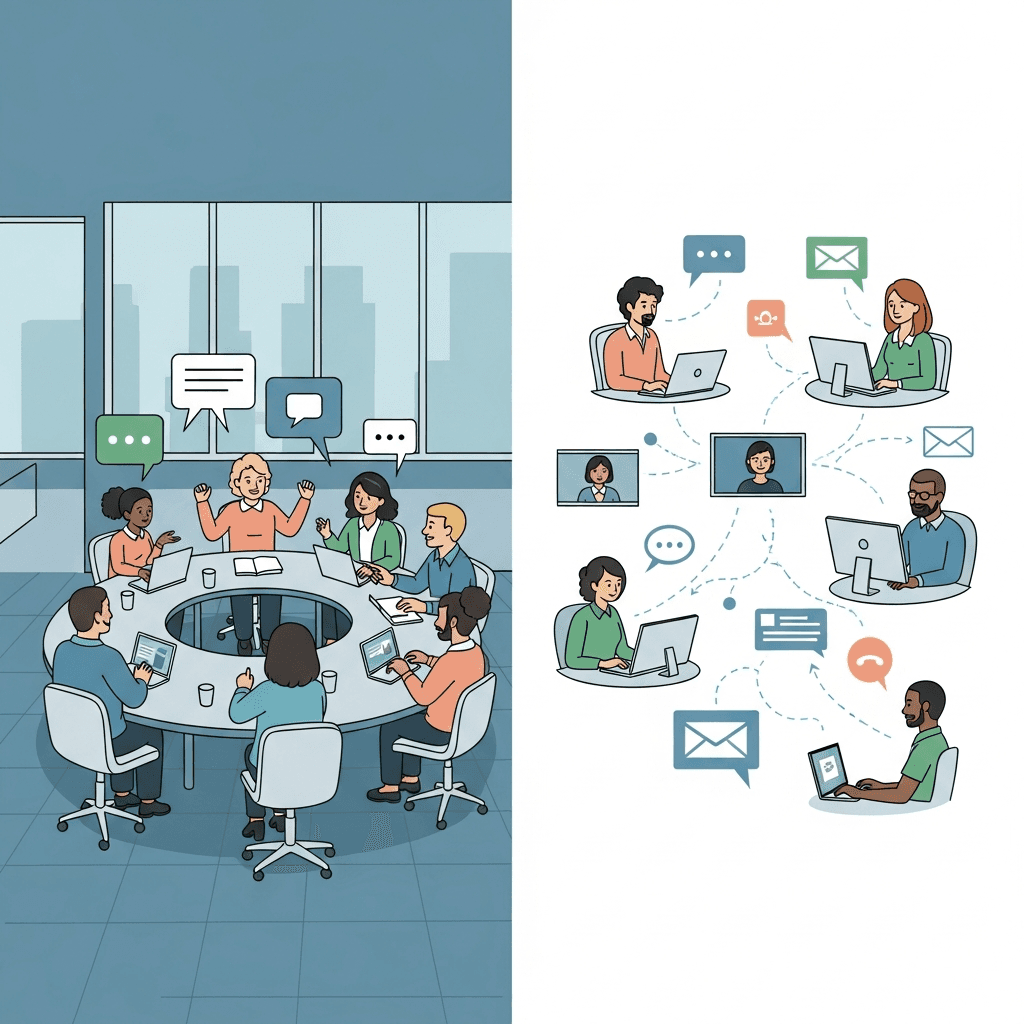
Asynchronous communication demands explicit context. Teams need training on documenting decisions immediately, recording meeting summaries for colleagues in other time zones, and providing detailed project status updates. What seems excessive in real-time becomes necessary when teams work hours apart.
Preventing Information Silos
Hybrid teams split between office and remote locations create knowledge gaps. Training must build habits like sharing informal conversations in shared channels and having remote participants speak first in meetings to prevent in-office discussions from taking over.
Communication Strategies for Frontline and Deskless Workers
Frontline workers face distinct communication barriers. Only 23% have the tech they need to be productive, and training portals fail employees without desk time or computer access.
SMS and WhatsApp delivery solves this access problem. Training messages arrive on personal devices during breaks or between shifts without requiring app downloads or portal logins. Short lessons fit into workflow pauses instead of demanding time away from floor operations.
Effective frontline communication training focuses on immediate job needs: safety protocols, equipment updates, procedure changes, and shift handoffs. Content must be scannable in under two minutes and uses spaced repetition instead of single long sessions.
Measuring Training Effectiveness and Communication ROI
Communication training requires data beyond completion rates to prove real impact. Track retention through follow-up assessments weeks after training ends. Quiz scores that remain stable show lasting knowledge, while drops signal where reinforcement is needed. Compare pre-training and post-training performance on tasks like email clarity, meeting length, or customer interactions.
Behavioral metrics reveal actual change. Monitor meeting duration, email response times, project revision cycles, and conflict escalation rates. Teams with strong communication see productivity gains up to 25%, making these functional changes direct ROI indicators.
Manager observations and peer feedback capture improvements that data alone misses.
Creating Feedback Loops and Continuous Communication Development
Communication skills develop through consistent practice and targeted feedback, not isolated training sessions. Repetition converts learned concepts into workplace habits.
Peer review systems generate real-time feedback loops. Employees can review each other's emails, presentation drafts, or meeting facilitation using specific rubrics. This builds self-awareness and normalizes constructive critique outside formal review cycles.
Manager coaching should reference specific communication moments instead of general advice. Pointing to actual situations ("Your project update buried the budget concern in paragraph three") creates clearer learning pathways than abstract guidance.
Spaced reinforcement through brief refreshers maintains skill retention. Weekly micro-lessons via SMS or messaging apps keep core concepts accessible, allowing employees to revisit techniques as situations arise and building competency through ongoing practice.
Implementing Organization-Wide Communication Training Programs
Executive support determines whether communication training succeeds or stalls. Leadership needs to connect training directly to business outcomes like faster onboarding, fewer project delays, or higher customer satisfaction scores.
Match your delivery method to how employees actually work. Desk workers can train through Teams or Slack, but frontline teams need SMS-based lessons that arrive on personal devices without requiring logins or app downloads.
Build training into existing workflows instead of scheduling separate sessions. Short lessons during shift changes, inside team channels, or during natural work breaks keep people learning without stopping their work.
Customize examples for each department while keeping the core framework consistent. Sales teams can practice handling objections, while operations teams focus on clearer shift handoffs. Different scenarios with shared principles work better than one-size-fits-all content.
How Teams Build Stronger Communication Skills with Arist
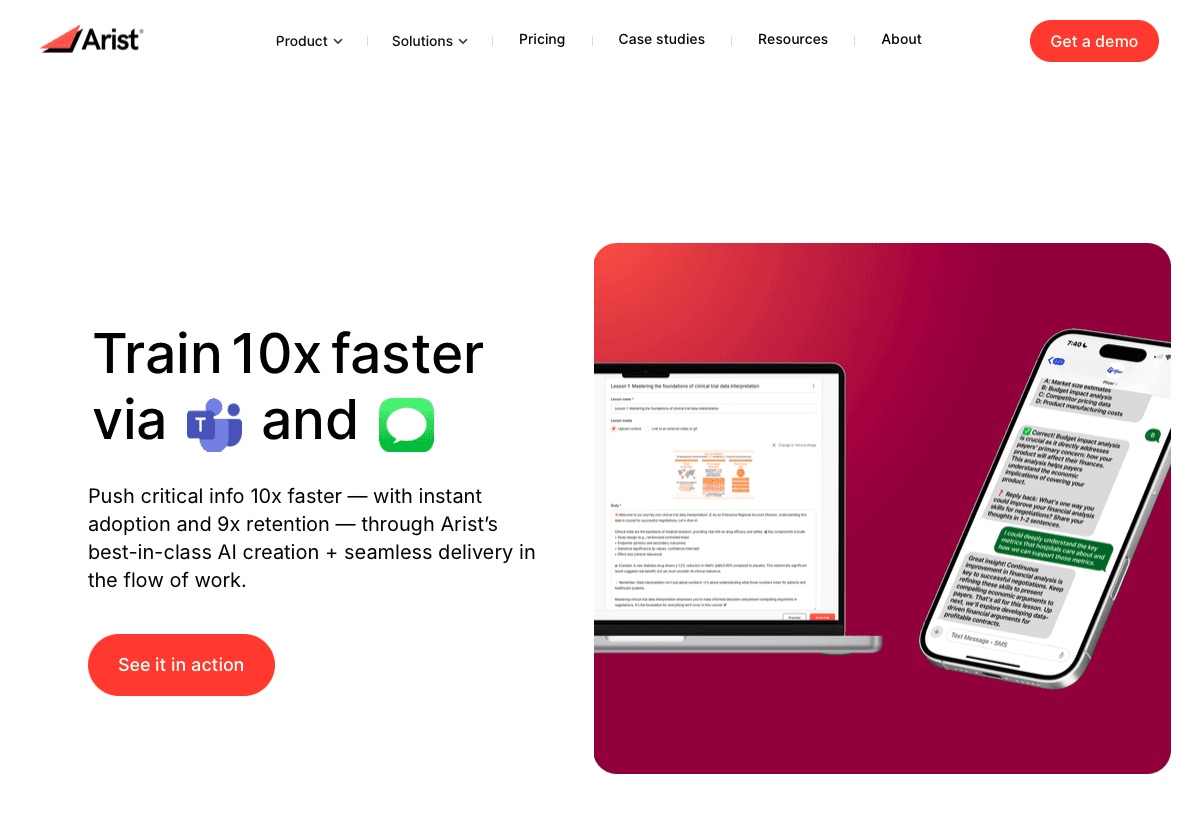
Communication skills improve through repetition, feedback, and real-world practice, not one-time workshops. Arist helps organizations turn communication training into an ongoing habit by delivering short, interactive lessons directly through SMS, WhatsApp, Teams, and Slack. Instead of pulling employees into separate portals or long sessions, Arist brings active listening drills, writing exercises, feedback frameworks, and quick knowledge checks into the same tools teams already use to communicate every day.
Organizations use Arist to train desk-based and frontline teams at the same time, reaching employees without computer access while maintaining consistent standards across roles. Built-in AI automates lesson creation, delivery, reinforcement, and measurement, making it easier for HR, L&D, and enablement teams to track real behavior change through metrics like meeting length, message clarity, and rework reduction. Trusted by companies including Microsoft, Pfizer, and Ford, Arist helps teams move from talking about better communication to practicing it daily, where alignment, productivity, and trust actually improve.
FAQs
What communication skills should frontline workers focus on?
Frontline teams benefit most from training on shift handoffs, safety protocol updates, equipment change notifications, and quick problem escalation. These skills need delivery through SMS or WhatsApp in under two minutes to fit between tasks without requiring computer access.
How can remote teams prevent information silos during hybrid work?
Train employees to document decisions immediately in shared channels, record meeting summaries for colleagues in different time zones, and have remote participants speak first in meetings. This prevents in-office conversations from excluding distributed team members.
What's the difference between active listening and just staying quiet?
Active listening requires asking clarifying questions, summarizing what you heard before responding, and confirming understanding instead of mentally preparing your reply. Training exercises that force learners to repeat back information before answering build this skill faster than passive observation.
Final thoughts on strengthening team communication capabilities
Strong training and communication doesn’t improve through awareness alone; it improves when teams practice it consistently inside their daily work. Employees already know communication matters, but progress comes from clear frameworks, regular reinforcement, and feedback applied in real situations. That’s why organizations pair skill-based training with delivery methods that show up where work actually happens. Solutions like Arist weave communication training into everyday tools, turning listening, writing, and feedback into habits instead of one-off lessons. When communication training becomes part of the workday, alignment improves, friction drops, and better collaboration becomes the standard instead of the exception.
Jasper Ng
Bring
real impact
to your people
We care about solving meaningful problems and being thought partners first and foremost. Arist is used and loved by the Fortune 500 — and we'd love to support your goals.
Curious to get a demo or free trial? We'd love to chat: